One question for building your next AI agent (JTBD)
🕳️ “People don’t want to buy a quarter-inch drill, they want to buy a quarter-inch hole.” – Theodore Levitt
Hello Reader,
Projects fail if they aim too wide.
That was the central theme of last week’s workshop in the AI Agent Accelerator, the 4-workshop sprint where we build, deploy, and fine-tune AI agents.
Using my 4-step SAGE framework, every week we:
SCOPE agentic projects
AUTOMATE robotic work
GENERATE skills and system prompts
EVALUATE effectiveness
Projects succeed and fail on their scope.
A well-defined scope creates focus, sharpens judgment, and concentrates ambition to a precise outcome. The scope of a project is the minimum required to get the maximum result.
Defining a project’s scope helps you defend against creep.
Prompt: make an adventurous image of Scope Creep in my signature style
You can do anything you want, just not all at once.
Having a good scope helps you clarify what’s in the project, what’s out of the project, and what it’s worth to you when it’s complete.
The situation of the scope – where you find yourself, the direction you’re facing, the destination that has your focus – these are best clarified using the Jobs-To-Be-Done formula.
The Buyer’s Real Reason
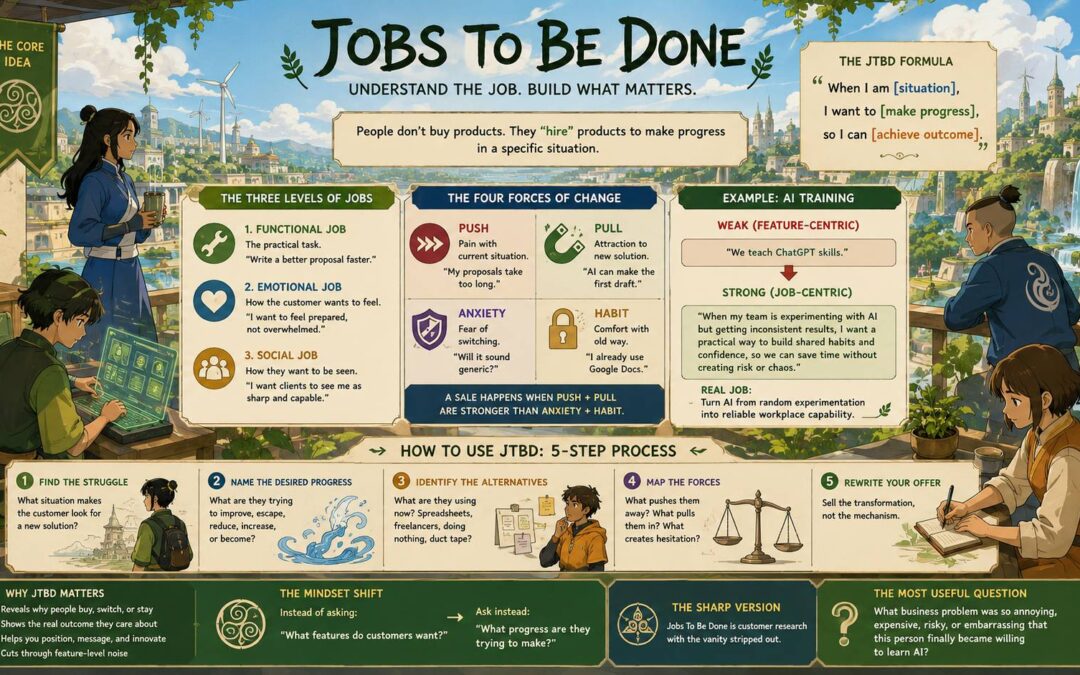
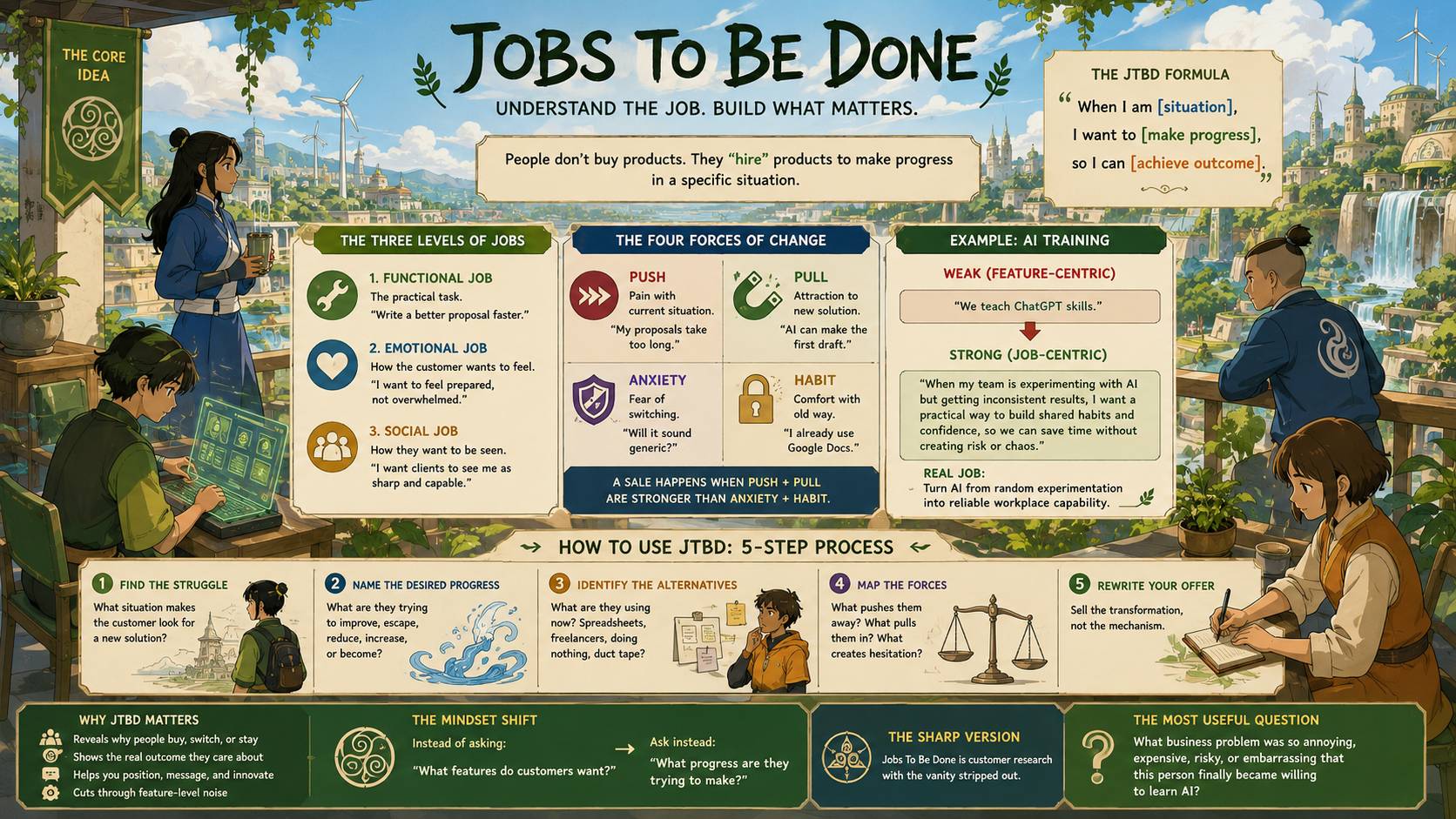
Jobs To Be Done is a strategy framework for understanding why people buy, use, switch, or abandon products. The core idea is that people don’t buy products. They “hire” products to make progress in a specific situation.
By applying this framework to AI agents (whom you “hire” to accomplish something) you can identify what, specifically, transitions you from an initial state to a goal state, and why it matters.
The basic formula goes like this (replace words in CAPS) –
When I am SITUATION, I want to PROGRESS, so I can OUTCOME.
Prompt: make an infographic with JBTD frameworks in my signature style
🤖 Managing Multiple AI agents
If you can define the Job To Be Done for each agent (and subagent) you will move beyond random chaos, and into structured management.
Managing AI agents is going to be a valuable skillset in an AI-powered future. My professional advice: hire a couple of agents to do regular tasks for you. Gain some experience. Practice. Fail. Learn. Grow.
Ask yourself this one question: what is the job to be done?
Here are some JTBD situations that can help inform your scope:
When I start my workday, I want an AI agent to review my email inbox and send me a priority report at 8am, so I can focus on the messages that need action first.
Before I wake up, I want an AI agent to scan recent news each morning and summarise the top developments, so I can spot trends quickly without spending an hour reading.
When I finish client meetings, I want an AI agent to turn the recorded transcript into action items and a follow-up email draft, so I can keep momentum without doing admin manually.
When I publish a new article, I want an AI agent to repurpose it into LinkedIn posts, email snippets, and short social captions, so I can get more reach from the work I already made.
When I contact new leads or old prospects, I want an AI agent to log the activity, and suggest next steps, so I can follow up at the right time with less mental clutter.
In an era of infinite intelligence, clarity of thinking becomes more valuable.
📰 New AI News This Week
The US Government suspended access to Fable 5, the nerfed version of Anthropic’s ‘too-dangerous-to-release’ Mythos 5
Argentina’s president Javier Milei proposes zero-person corporate structures for AI agent-led companies
Google upgraded NotebookLM with Antigravity, agentic AI features that allow a cloud computer to write and run code supporting your Notebook (for AI Ultra plan only)
Apple Intelligence announced at WWDC 2026 that Siri will ship on iPhone 17, but not to the EU (because of the Digital Markets Act, which would require giving all AI providers the same deep access to the phone’s hardware)
SpaceX & the Sentient Sun by Marc Andressen – “You cannot think your way to perfect solutions for problems you do not fully understand. Reality is the only adequate validator, and the trick is making it cheap enough to consult often.”
The quick shall inherit the earth by Jeff Huber – “The firm is its coordination friction. That friction is not a defect in the firm. It is the substance of the firm. The firm is a bundle of labor, context, coordination, decision rights, accountability, memory, process, and trust. This is why nearly everything a knowledge worker does all day (and which is almost never named as work) is the management of internal transaction costs.”
The Moral of Fable by Dan Shipper – “When you garden, you’re creating a loop. You water and weed, prune and stake, establishing and maintaining the optimal environment; the plant itself does the growing. Likewise, developers are now creating the optimal conditions for a product to grow and improve. Tending the work is the loo.”
This Friday, 1pm NZ time / 11am AU // Thursday 6pm Pacific
Live demos, comparison of dashboards, and parallel prompting!
Friday, June 19 at 1:00 PM GMT+12
Hermes vs OpenClaw
AI is evolving beyond chatbots. The next wave is autonomous AI agents: systems that can remember, reason, operate tools, manage workflows, and act on your behalf. In this live AI Coaching Academy webinar, we’ll compare two of the most talked-about agent ecosystems in the open-source AI world: ⚚ Hermes by Nous Research — the self-improving…