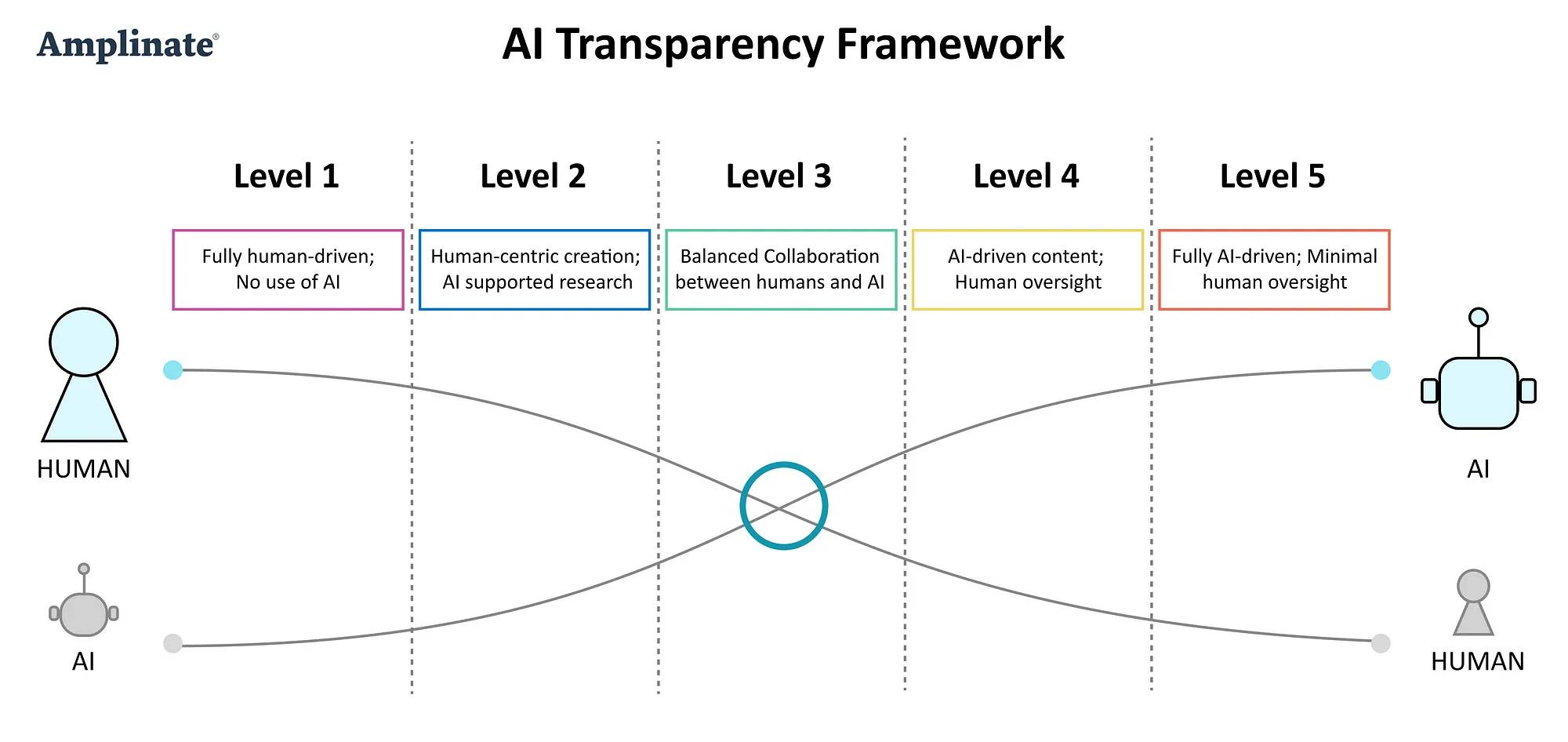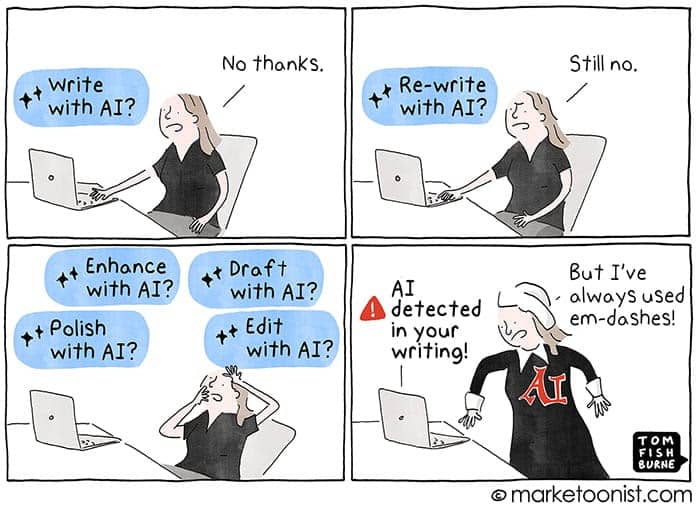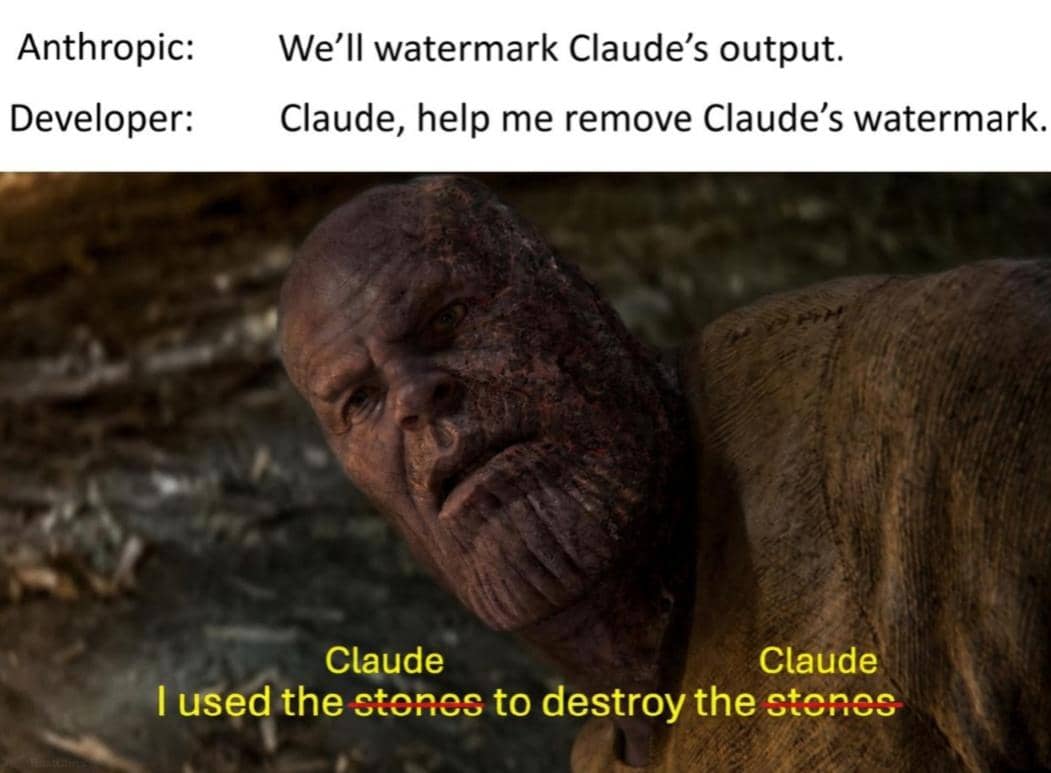
I’ve been known to crop these out, when I don’t want to visually advertise the source. If I had used any AI to compose the text of this newsletter, it would also contain an AI Watermark – invisible proof it is somewhere below Level 1 on the Amplinate AI Transparency Framework:
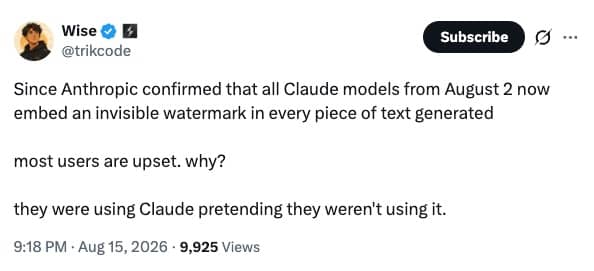
💡 Any AI use can be watermarked.Anthropic recently announced a controversial text watermark to comply with the new EU AI Act, a set of regulations that require providers to ’embed technical solutions that enable marking in a machine readable format and detection that the output has been generated or manipulated by an AI system and not a human.’ If you use Peter Yang’s 25/50/25 rule for editing with AI, you would land at Level 2 or 3, but you would be watermarked by Claude as if you were Level 4 or 5.
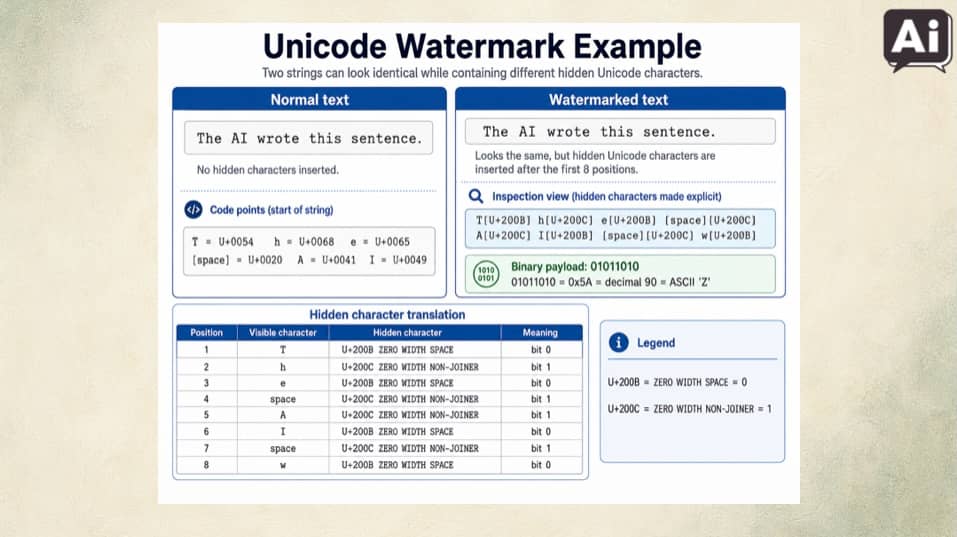
While it’s easy to punch down on AI slop cannons, it has a lot of heavy AI users concerned. The new AI Watermark does not distinguish how much AI was used, only that AI was used. People creating large volumes of high-quality content, assisted by AI, are now at risk of being lumped in with people creating low-quality content, since they are all AI watermarked. 🔍 How does this work?The new AI Watermark that Anthropic is releasing is based on patterns, and not zero-width Unicode characters. Some other AI watermarking systems insert zero-width Unicode characters that can be stripped out with some clever copy-pasting. Here’s an example from my recent presentation at the Christchurch Artificial Intelligence meetup group, Create a Brand Voice Kit, where I demonstrated how zero-width Unicode characters can be hidden within writing:
If you copy: The AI wrote this sentence.
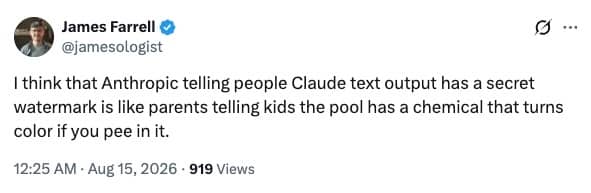
and paste it into an invisible text remover you will see the zero-width Unicode characters embedded in the text above. Including this in my newsletter, and publishing it on my blog, may flag me for AI Slop. Or it may not – there is a good chance James is right, and this is all being used as a deterrent:
Anthropic’s new AI Watermark is based on Google’s SynthID, and it uses pattern recognition to flag AI generated-text. The distribution of text choices in generated content will contain a pattern that is recognisable to other AI systems. This is core to the controversy – if Claude is not choosing the best next word, but is instead choosing the word that will align with the required pattern to watermark the text, then it isn’t generating you the most valuable text content (or code…) it is generating whatever can both match its watermarking pattern, and become a good response to your prompt. Another component to the controversy is – if this is a requirement for EU users, why did Anthropic implement this feature worldwide, for all users? The third (and most consequential) part of the controversy is how AI watermarked-text will be treated. What happens if having a watermark turns into a proverbial Scarlet Letter, lowering your SEO rankings because AI helped you polish your headline? What if your social media captions flag that you are an AI user, penalizing your reach?
🤖 AI as a Research PartnerWhile I did compose this article entirely by hand, I also used AI in a separate window as a research partner. This newsletter is Level 2 on the AI Transparency Scale. When I copy/paste this text into AI detection software, it ranks as 100% human written:
The only AI used in this article was for research. When I wanted to flesh out a concept (like the EU AI Act, or details about the new Anthropic watermark) I am asking Grok in a separate window for research and details. The common prompt I use for this sort of research assistance is: Tell me about…
I really like using Voice Mode for this when I am on the go. It’s like having a little research minion perched on my shoulder, willing to fetch any up-to-date research to satisfy whatever whim I can articulate. I also like using Grok for super-recent research; with it’s tight embedding with the X feed, I get the most up-to-date links and takes from the global town square. ✏️ How to remove an AI watermarkLet’s say you produce a first draft in Claude. It looks fine, but you want to make sure it doesn’t contain the pattern that flags it as AI-generated content.
The third option is something I do quite a lot with AI-generated text – I will stress-test it by bouncing it between models. I will take Claude’s output, ask ChatGPT to critique it as a senior creative director, and give those notes to Claude. I’ll take the revision back to ChatGPT, and transfer the new set of notes back to Claude. At some point, I will have a draft that is ready for a human line edit. This back-and-forth is helpful because LLMs are better at evaluating content than generating content. You only get limited effectiveness by having AI write your first draft. If you can be the editorial director, and choreograph a team of agents collaborating on your project, you won’t just get the 80% quality that any AI slop cannon can create. The last 20% to perfection relies on multiple revisions.
|
What is an AI Watermark? (And should you avoid them?)